

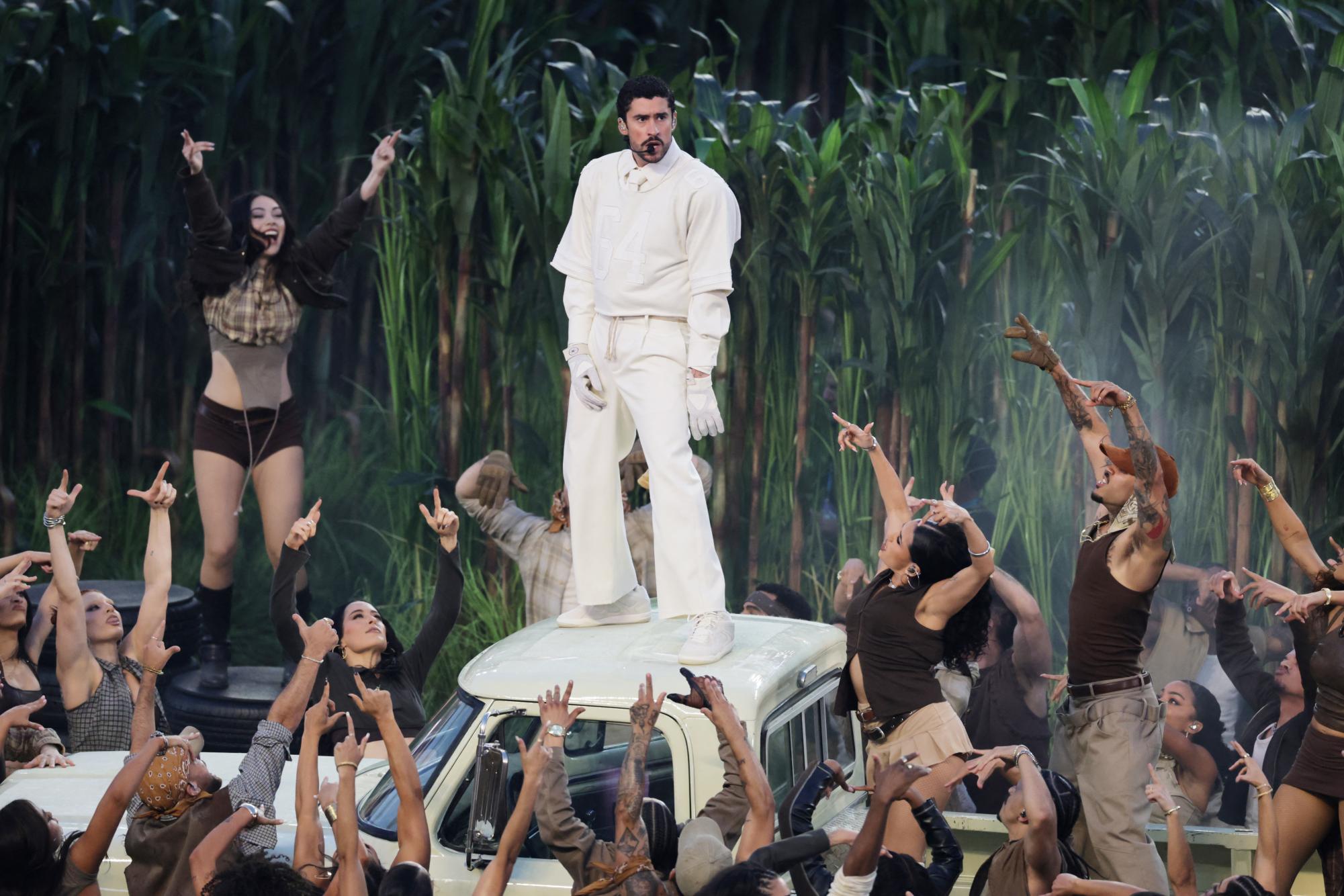
The title “America” typically refers to the United States of America; however, at the Superbowl halftime show on Feb. 8, 2026, Latino music artist Bad Bunny (Benito Antonio Martinez Ocasio) represented all nations in the American continent.
Bad Bunny’s inclusion of all American countries in his halftime show resonated with many Americans, including those at Masters. Latinos Unidos co-chair Valentina Valdivia ‘27 said she appreciated the representation of the country from which her family originates.
“I was so excited when [he said] Peru because Peru is obviously famous for Machu Picchu, but it’s so underrepresented in the media because every Hispanic person [I’ve seen] in movies or books [never represents Peru]. I never get to see myself represented in anything. I think it was the same experience for a lot of different people; I have friends who were so excited to hear Jamaica being called,” she said.
Honoring Puerto Rican Culture:
The halftime show opened with a man playing a guitar in front of a sugar cane field backdrop, saying “Qué rico es ser latino. Hoy se ve.” Translated into English, he said, “How beautiful it is to be Latino. You can see it today.”
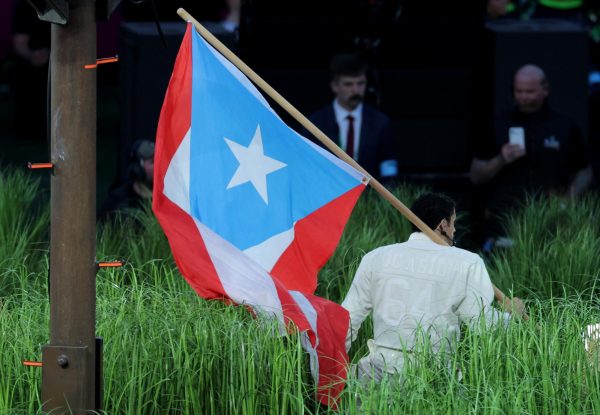
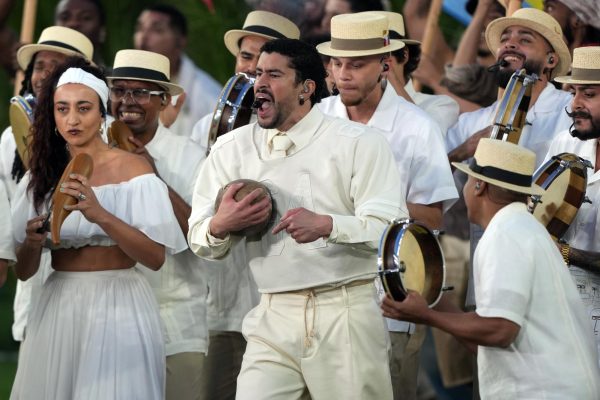
Bad Bunny’s performance especially highlighted the beauty of Puerto Rican culture. As the camera rose above the fields, viewers witnessed a line of white-dressed jibaros wearing pava hats, or traditional straw hats, cultivating the land. From Spanish colonialism until the late 1960s in Puerto Rico, sugar plantations were the center of the island’s economy and are a nostalgic symbol of Puerto Ricans’ persistence and hard work. Jibaros, the folkloric image of Puerto Rican countrymen workers whose stories are commonly told through Puerto Rican music, stemmed from the plantations.
When the screen shifted to Bad Bunny, he began singing his popular song “Titi Me Pregunto,” or, in English, “Auntie Asked Me.” During the song, he passed a coco frio (frozen coconut) stand and a table with four older gentlemen playing dominos and dressed in tropical-printed guayaberas, a type of linen or cotton shirt popular in the Caribbean. Other symbols, like a piragua stand, barbeque grill and a real-life wedding demonstrated the lively culture of Bad Bunny’s native island of Puerto Rico.
Representing Nations Across the Americas:
However, the performance did not just focus on Puerto Rican culture. During his performance, dozens of flags of all the countries in the North and South American continents paraded down the fake sugar fields as Bad Bunny listed the nations and exclaimed, “God Bless America.”
Even though Valdivia is not Puerto Rican, she said there were moments during the halftime show performance that she felt were universal to most Hispanic cultures.
“I feel like certain moments of his performance I literally could just relate to. Like when [Bad Bunny] was trying to get a kid to stop sleeping on the chairs [during the wedding]. No one can understand that moment unless you kind of lived through it [during Latino family events],” Valdivia said.
Valdivia also said the inclusion of all the American countries in the performance was powerful because it conveyed the reality of what the United States is: a country composed of individuals from many nations and cultures.
Mixed Reactions
The halftime show did face a lot of backlash from individuals online, including President Donald Trump, who believed the performance did not properly depict the United States and disliked that the entire show was in Spanish. Many users on X claimed Spanish had no place in the Super Bowl because English is the most common language spoken in the U.S., with 78 percent of the population speaking only English.
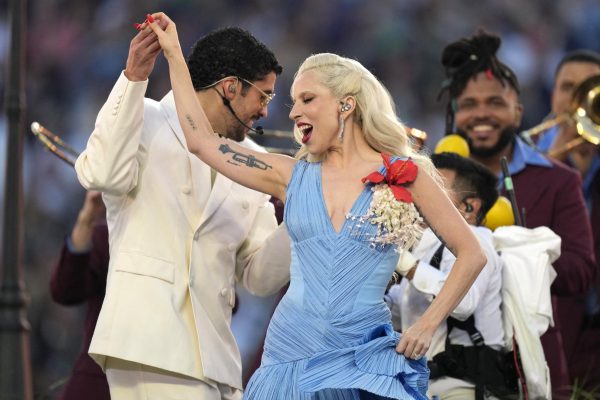
The performance subtly reimagined the meaning of the popular Trump administration slogan “Make America Great Again,” (MAGA) when guest singer Lady Gaga wore the Flor de Maga, Puerto Rico’s national flower, on her light blue dress. While “MAGA” has often been associated with policies supporting deportations of Latin-Americans, the featuring of the Flor de Maga during Bad Bunny’s performance conveyed that America is great because it is made up of Latinos and immigrants from all nations across the continent.
Despite Lady Gaga’s floral symbolism, individuals online have expressed their anger at her performance during the halftime show, saying another Latino artist should have sung instead. Lady Gaga sang the English song “Die with a Smile,” while a couple got married on the roof of a small, pastel-colored house.
Valdivia said she enjoyed Lady Gaga’s performance, even though many believe another Hispanic singer should have replaced her.
She said, “With Lady Gaga, I know a lot of people were saying that she wasn’t the best [choice], like that they should have had another Hispanic singer, but I honestly thought she was great. I feel like we expect too much of [Bad Bunny]. Any white performer can do something that’s half as good as what he does and everyone is still satisfied. Meanwhile, there was so much pressure on him to be so good as the first Latino solo artist, not just from the Hispanic community, but from all the other communities who were like, ‘Oh my god, he’s our one chance, and he can’t mess this up.’ And then everyone says it was underwhelming.”
She continued, “It makes me kind of angry cause I was like, ‘Are you joking?’ The whole point [of the] performance is not meant to satisfy everyone. It’s a performance meant to have people confront the harsh reality of the world right now.”
Defining “America”
In the Advanced Topics in Spanish Language and Cultures class, taught by Roberto Mercedes at Masters, students have been learning about the definition of the word “America,” and whether “America” encompasses the entire continent or just the United States.
As one student in the class, Emilia Teodorczuk ‘27, said, “The general idea from those living in the U.S.A. is that ‘America’ is related to the U.S., and that [‘American’ means] a U.S. citizen. In Spanish class, we’re talking about how that’s not quite true, that America is not only one but two different continents.”
Teodorczuk said she appreciates learning more about Hispanic culture through songs and dances taught in the class.
She said, “It’s really nice to learn Spanish through the lens of culture rather than [just focusing on] grammar and things like that. It’s really nice to learn about these cultures, because as a kid, I felt like I was always learning about Europe and certain parts of Asia, so I think the countries and cultures taught to us are normally very filtered.”
Remembering Hispanic History
Similar to Mercedes’ Spanish class, Bad Bunny showed viewers Hispanic history using dancing and singing during the halftime show.
Ricky Martin, a guest singer during Bad Bunny’s performance, sang a short part of the song “Lo Que Le Pasó a Hawaii,” a song warning against the colonization and gentrification of Puerto Rico. In the lyrics, Bad Bunny worries about the culture of Puerto Rico being lost as land is bought by wealthy developers and changed in order to cater to tourists, displacing native Puerto Ricans. Since both Hawaii and Puerto Rico were annexed by the U.S. in 1898 after the Spanish-American war, the song compares the exploitation of both cultures.
Bad Bunny’s performance also taught viewers about Puerto Rico’s recent history, without even using lyrics: dancers during the Superbowl performance climbed up poles to reach electricity lines, referencing Puerto Ricans repairing the island’s electricity lines themselves after Hurricane Maria in 2017. That year, the U.S. government faced a lot of criticism for quickly providing aid to Texas and Florida, who were also hit by hurricanes, while there was a delay in supplies provided for Puerto Rico. The original official death count of Hurricane Maria released by the Puerto Rican government was 64, the number written on Bad Bunny’s jacket during the Superbowl Performance. The number was later corrected to about 3,000 deaths.
Bad Bunny’s halftime show provided representation and education of the cultures in the American continent. He reminded people that being American doesn’t mean speaking the same language or belonging to the same culture.
Valdivia said, “We have this notion that America is the greatest nation on Earth, and that we should consider [the U.S.] as the entirety of America, but in reality, there’s so many more countries that the diverse term ‘America’ [encompasses].”