

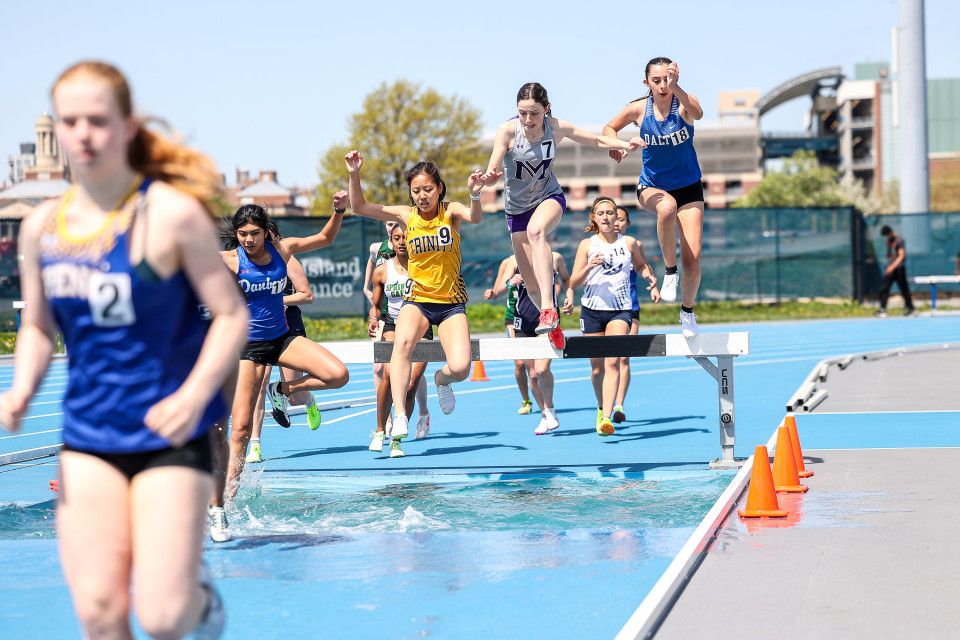

At the sound of a pistol, runners bolt off to the 3000 meter obstacle-ridden race known as “steeplechase”. In it, racers must dash through a specialized 400 meter track, featuring 28 fixed barriers and seven water jumps, totalling 35 obstacles in this high-level competition. This isn’t contained to the professional running world exclusively, though. At Masters, we have an event of our own.
Three times per year, runners at Masters take part in a steeplechase event: two in April and the New York State Association of Independent Schools (NYSAIS) championship in May. Last year, athletes Jamie Milward ‘26 and Liam Chappelear ‘27 ran first and second place, a record-breaking win for the school.
Despite the wins, the steeplechase event isn’t easy. Runners must go through a five lap-400 meter track with 36 inch barriers (for men) spread across. Milward said, “With just running for a long time, your legs are tired and you get out of breath. But with the steeplechase, there’s another dimension to that where you get so fatigued not just from the running, but also from the jumping. It’s a different kind of exhaustion.
As with any sport, there’s also the risk of injury. Helen Gimbel ‘28 has been running the steeplechase since she was 13, and has since developed a profound appreciation for it. But last year, when running at an event, Gimbel had shoe spikes driven through her ankle. “I kept running, even with a bleeding foot,” she said. Although it didn’t impact her ability to run the rest of the season, the injury showed Gimbel the steeplechase event in a new, hazardous light.
The steeplechase track event wasn’t always for humans. It actually began in horse racing, where horses would navigate hurdles, fences and ditches in a long-distance competition to the finish. Only in the mid-19th century was steeplechase adapted to be run by humans at Oxford University. In 1920, it became an olympic sport. Today, while still more “underground” than the other track events, steeplechase is considered to be a growing, exciting and unpredictable event, especially at the collegiate and elite levels.
Even though it’s not the top event, there is a uniqueness to steeplechase that makes it especially enjoyable, according to Milward. “It’s just kind of the perfect niche combination of distance and hurdling,” Milward said.
He continued, “If you run it in the middle of the summer it’ll be a really hot day out, so a splash of cold water is nice to have.”
The uniqueness of steeplechase is both a blessing and a curse for its runners. While it’s a highly rewarding and fun event, its lack of popularity and specialized track makes it difficult for runners to find the time to practice. “You have to find the time to practice the barriers, and you can’t really, since we don’t have a water pit at Masters,” Gimbel said.