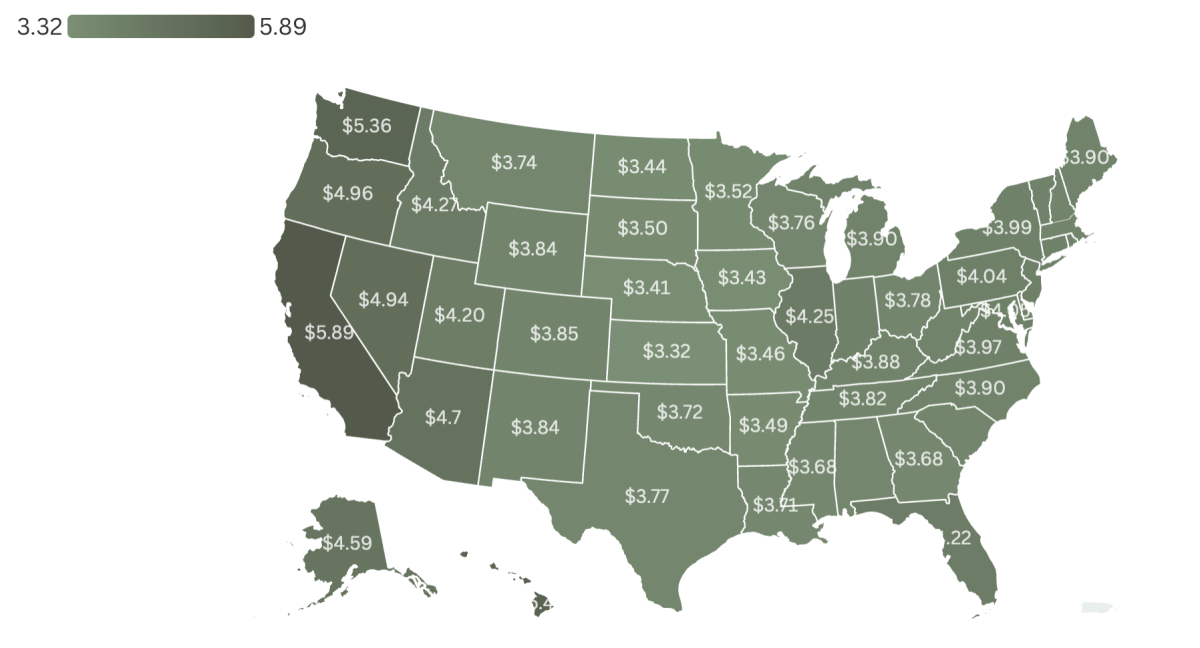




As of May 11, 2026, the average price per liter of gas in the United States is 1.270 USD (which converts to about 4.81$ per gallon).
In Thailand, the average price is 1.631 USD (about 6.17$ per gallon).
Sue Leelasakuntham ‘27 has family in Thailand. While people in Southeast Asia have gas for cooking and planes, they no longer have easy access to fuel for their cars and motorcycles.
“They’ll have to wait in line until there is [a tank of] gas for them to take… [They’ll use that] just for a bit, and then they’ll burn out again and have to repeat the line,” Leelasakuntham said.
Schools in the region have gone online or begun relying on trains. Jobs and acquiring resources remains challenging.
The United States and Iran conflict began February 28, when the United States attacked Iran. The Strait of Hormuz, which allows the passage of around one-fifth of the world’s oil and gas supply, quickly became a target point of the conflict.
The Council of Foreign Relations explained that on March 11, “[Iran] announced that any vessel belonging to the United States, Israel, or their allies in the area were considered ‘legitimate targets’”.
This announcement was followed on March 12 by Iran’s supreme leader, Mojtaba Khamenei, saying the strait would continue to be blocked off.
Upper School Economics Teacher Skeff Young explained that with the Strait in risky condition, insurance companies raise their prices for insuring a tanker.
The companies owning the tankers eventually can no longer afford the insurance, resulting in “a bunch of oil tankers sitting inside the Strait… that can’t get out,” he explained.
Southeast Asia and the Oceania regions rely on the Strait of Hormuz specifically. While places like the United States and Europe have other sources of oil, places like Vietnam, Thailand, and the Philippines depend on the nearby Hormuz.
Young lived in the Philippines for five years and still has connections there. For people in the Philippines, the economic crisis is not only making public transportation (which Filipinos often use instead of personal cars) more expensive, but also removing the ability for individuals to cook and prepare food items in order to make meals accessible.
“In the Philippines, the average person uses little natural gas containers, like you do for your grill. That’s how they feed themselves… very quickly, the average person in the Philippines is going, ‘Where’s the natural gas, and how much is it gonna cost me to get it?’”
Australia, in the Oceania region, is another heavily affected country, relying similarly on exports and the Strait. Hunter Smith ‘29 has family in Australia.
“All of the farming culture is completely gone,” he explained.
Outside of cities, farming is extremely common in Australia. The New York Times explains that Australian farms require tons of diesel gas- the national average cost of which rose about 50% in March.
Fertilizer also isn’t coming through the Strait, adding another layer of concern for farmers having to decide whether or not to invest in their crop this season.
Smith said he knows many Australian farmers who have been forced to call their crop and sell their farms, losing the primary job in a region with no universities and few other ways of life.
“I have friends who are like, ‘I don’t really know what to do now’, because that’s pretty much all that they do,” Smith explained.
Re-opening the Strait will be the first step to solving these issues, Young explained. After that, the process will begin by rebuilding trust for insurance companies in order to lower the price enough for ships to start paying and continuing their shipments.
“It’s not like the next day everything’s going back to normal… This is going to be a process,” Young warns. “[But] it’s in the interest of everyone to get this settled.”