


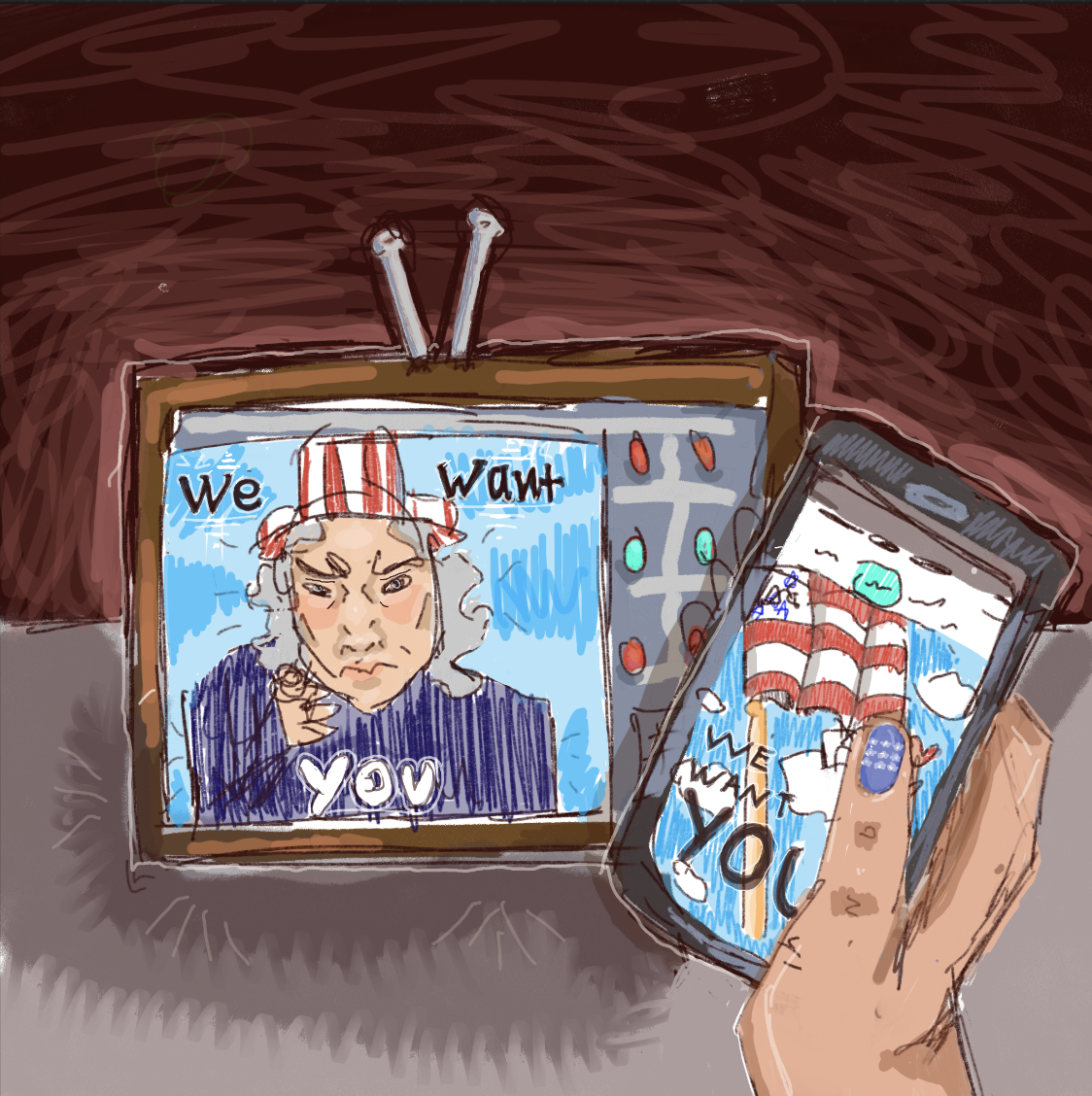
When students scroll through Tiktok, they can encounter topics spanning from funny stories, cool cooking recipes, makeup tutorials and movie clips all the way to emotional footage of wars or protests happening in major cities. Current events constantly infiltrate social media algorithms, shaped by the biased perspective of the individual relaying the information. Although Americans no longer have Uncle Sam posters hanging outside retail stores, digital propaganda still infiltrates daily life.
While propaganda is usually used by governments to push certain narratives, messaging has also been used by individuals in opposition to the government.
For example, when trying to increase support for the revolution against Great Britain, Paul Revere famously depicted the Boston Massacre in an engraving in 1770, shaping public perception of the event by portraying the soldiers as the main aggressors, even though in reality, the colonists attacked first.
While Revere depicted the government’s revolutionary messaging through physical materials, the current White House administration uses digital methods for propaganda today.
On Jan. 22, the New York Times confirmed that the White House had altered a photo of a protester, which they posted on social media, using Artificial Intelligence to depict her as a crying, hysterical individual. In reality, the demonstrator was calm and collected when arrested.
AP American History and political science teacher Colleen Roche teaches about historical examples of propaganda in her American history classes. However, she pointed out that the information coming from the White House today is no longer just biased but plainly incorrect.
“What we’re seeing now is just flat out false. It’s not just with a biased lens. I don’t think we’ve seen that from the White House to the same degree in the past because we’re seeing [disinformation now] on basically a daily basis,” she said.
As disinformation spreads more easily through social media, students must learn to navigate the digital propaganda.
Although Roche states she is not an expert in detecting digital propaganda, in her political science class, Roche still teaches her students ways to analyze a news source. In order to determine accurate information, she recommends individuals read articles from politically opposite news outlets to fully examine news events.
For students, social media influences perspectives through the constant outpouring of biased information, and in some cases, completely false narratives. However, APUSH student Chloe Roh ‘27 said she recognizes that social media is not necessarily only used to spread harmful propaganda, but also used to unite individuals to a common cause.
Roh said, “There is strength that comes with [social media], too, in that, you can use those platforms to spread awareness [and] use it for a greater good. I feel like with protests being broadcast on national or local news, [you see] the power of the people coming together for a single purpose to make waves within the community.”