
In anticipation of national and midterm elections, a mass political survey was sent throughout The Masters School community on Oct. 10. Students and faculty answered questions that applied to current federal policy, rather than party allegiance. A set of seven questions asked about federal spending overall, and on specific programs ranging from welfare to defense spending. In terms of federal spending, the results were distinct. Only 16% of Masters respondents (staff, faculty and students combined) felt that the government should increase overall spending, and apart from those who were uncertain, 48.7% wanted to keep spending the same or reduce it. At the same time, there were calls for increased specific government spending. 63.8% of all those who participated believed that safety net and low-income assistance should be increased, while only 12.9% believed that aid programs should be kept the same and only 6.6% believed that the federal aid budget should be decreased. 67.9% of Masters respondents believe in an increase in funding for science, research and technology. An overwhelming majority, almost 75% of all respondents, believe in an increase in funding for climate change and emerging global weather patterns. The results might suggest that Masters wants it both ways: less spending overall and more spending on some specific programs. However, a potential way in which participants offset this desired increased spending was in a call for a decrease in the defense budget, which as many as 48% of respondents advocated for. Nonetheless, it is important to note that none of these questions featured quantitative data, including the actual amounts currently spent on these programs, and it was not clear that those who wanted reduced military spending also wanted increased social and science spending. How does Masters compare to the nation? Finding direct comparisons between these questions and similar recent national polls is not easy. However, a May 2026 USA Today poll shows that 59% of Americans do not fa- vor a current White House proposal to increase defense spending from 1 to $1.5 trillion. This largely tracks with the results from our school, although the questions were not exactly identical. In contrast, Masters respondents are much more likely than the national average to favor increases in spending for low-income assistance. A national Pew Research poll, conducted in the spring 2024, found that only 52% of participants supported additional aid to the needy and 45% of respondents said that “The United States can’t afford to do much more to help the needy.” This contrasts with the nearly 64% of Masters respondents who favor increasing spending for the needy. In general, pollsters see support of increasing federal spending as a left-leaning position, and cutting federal spending as a right-leaning position. If this is true, Masters is a relatively centrist place when it comes to overall spending, but leans left in terms of spending on social programs, science research and infrastructure. After these results came in, Masters student leader Noah Adler ‘27, who worked directly with Cait Conley, a democrat running for New York’s 17th congressional district, was not surprised by these findings. Adler said, “I think that when we look at these kinds of opposing ideas being supported heavily at Masters…it’s just based on our values as a school community, and…people all want other people to be safe and have the resources they need and the money they need to survive and to get by.” He continued, “Our identity as a school [is] just caring about other people…[but it] can sometimes be contradictory to what that requires.” Upper School English Teacher Paul West also reflected on the poll’s results – and the difficulty of answering some of the questions. It is notable that for some of the spending questions, over 30% of the responses indicated uncertainty. West said, “It’s easy to have an idea about a single area. But when you start putting that together into a larger theory of government, that becomes harder.” He continued, “But no, we shouldn’t neces- sarily be spending money on [the] military. [Perhaps] you’re not raising money for spending, you’re raising it to maybe pay down the debt. So it’s hard to capture the nuance in a multiple-choice format [of] one thought about this one direction in this one area.” These reflections highlight that polls can yield mixed insights. While simple qualitative questions allow participants to engage with their opinions, without quantitative responses, the extremes to which governmental change can be advocated for are undetermined.
School leans left on social spending, centrist on spending overall
October 22, 2026
Categories:
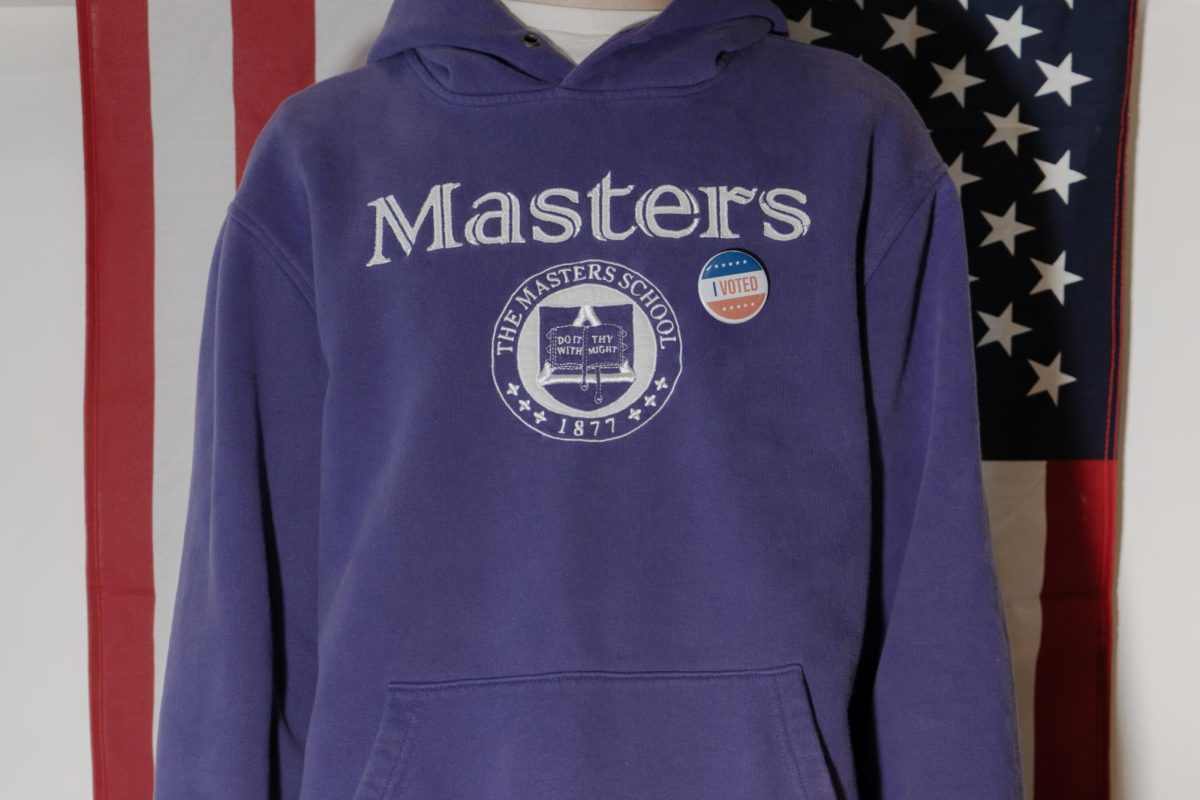
The Masters themed sweater dawns an “I Voted Sticker,” signifiying The Masters’ distinct political views.
More to Discover