
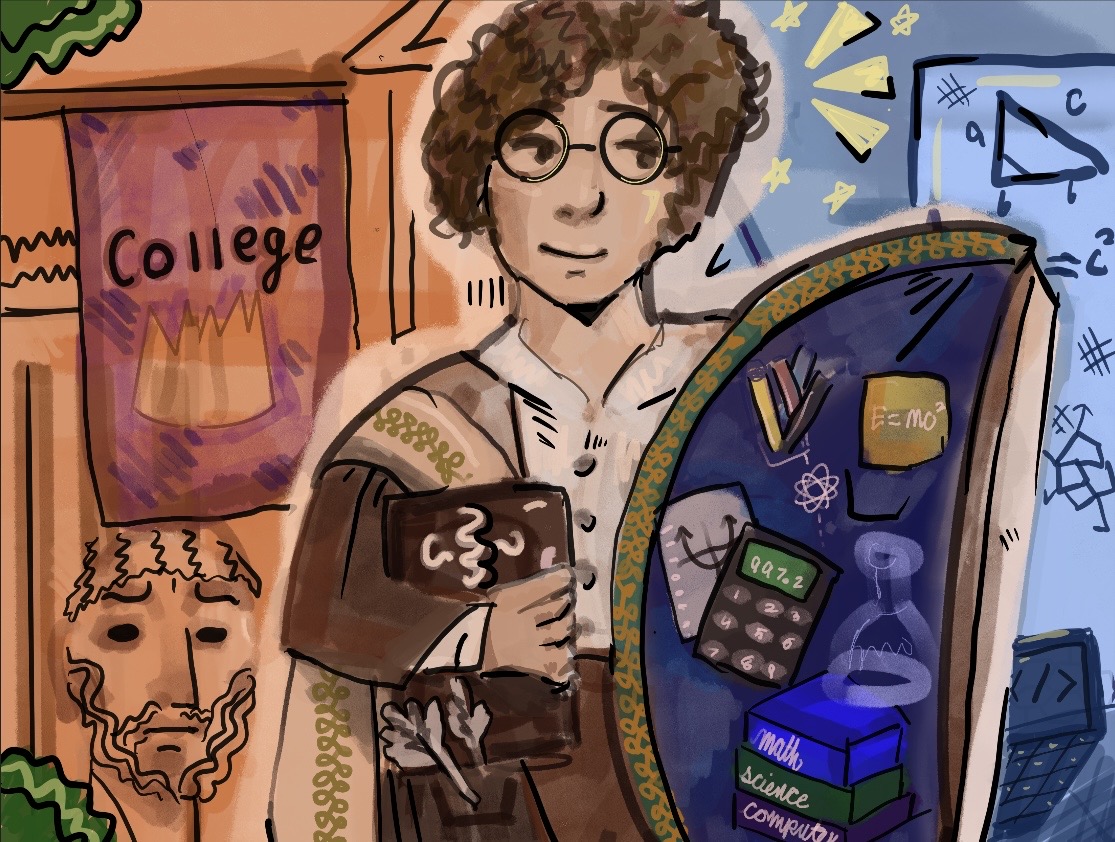
Academic work that centers people and expands historical archives is extremely important and cannot be done without human interaction.[/pullquote]Over the past three years, AI-related college majors have surged from 116 to 310. The United States Department of Education released $169 million to support AI teaching, as it is viewed as an indispensable skill for students of this generation. To boost the school’s engineering and computer science programs, Masters completed the construction of the Innovation and Entrepreneurship Center (IEC) in 2023. But as institutions expand investment in AI programs, resources and endowments for the humanities have correspondingly declined.
On April 3, Syracuse University halted 93 of the 460 academic programs, including majors like classical civilization, classics, German, Italian, Middle Eastern studies and Modern Jewish studies. A Syracuse spokesperson explained this adjustment to their program as making it more “practical” and “career-driven.”
Indeed, as technology industries continue to flourish, majoring in STEM seems to translate into a high-paying job. The New York Fed’s 2024 report consistently ranks engineering disciplines at the top for median salaries among workers aged 22 to 27. Growing concerns over the utility of humanities majors hinder many students and families from choosing it.
However, as technology advances, this assumption becomes increasingly misleading. Bill Winter, former CEO of JPMorgan’s investment bank, recently said technical skills are increasingly easy to outsource and automate. Adaptable “soft skills” traditionally associated with the humanities are growing more valuable.
Courtney DeLong ‘17, a Masters alumna who studied Folklore & Mythology at Harvard University, experiences this shift firsthand. “Many people my age were told that if you learned to code, you would always have a job, but now that is not really true,” she said.
For DeLong, those skills prove essential in her career. “My major taught me how to communicate complex topics clearly, such as explaining complicated policies in ways that different audiences could understand,” DeLong said. “It also taught me to think laterally and consider qualitative cultural impacts that may not appear in cost-benefit analysis,”
DeLong also pushed back on the stereotype that the humanities and STEM fields are inherently opposed. In fact, many studies are interdisciplinary. DeLong taught herself coding for her folklore project. “I ended up explaining the structure to my CS friends,” she said, “And they were all like, ‘Maybe the major was less silly than we thought.’”
The value of a humanities education goes beyond its occupational utility. For some students, it lies in creative exploration. For DeLong, the values come from the conversation it fosters. Reflecting on her research, which included months of oral history interviews in Louisiana, she said, “Much of what I learned came from those conversations, which could not have been gathered by scraping internet sources.” She added, “Academic work that centers people and expands historical archives is extremely important and cannot be done without human interaction.” Experience like this, while it may not serve students well in their first job out of college, will cultivate values that serve them well throughout their professional and personal lives.
For others like me, the core of humanities may be the freedom to think independently, without relying on external authority. At a time when artificial intelligence percolates every aspect of our lives, it has become a source of unquestioned authority for many who believe in its absolute correctness and accuracy. However, artificial intelligence is more imitative than it may appear. As AIs are often trained indiscriminately by vast bodies of existing writing, including those that contain past racial or gender prejudice, they naturally inherit these biases. This can be concerning as AI is often used in employment and policing. For this reason, AI should not be mistaken for a source of authority.
Enlightenment thinker Immanuel Kant defines education as cultivating the courage to “use one’s own understanding” to avoid passively relying on external authority. His idea explains why humanities education remains essential today. It should encourage trusting our own reasoning rather than outsourcing our judgment to a line of biased data.
Of course, no one should dismiss the importance of STEM fields and research. These areas drove essential developments in our societies and will continue to do so. But as schools expand technical training, they should not treat the humanities as expendable. One can hardly become proficient in any profession without a solid grounding in critical thinking.