


For years, the steady roar of gas-powered landscaping equipment had been a predictable soundtrack of daily life. Now, during much of the year, that
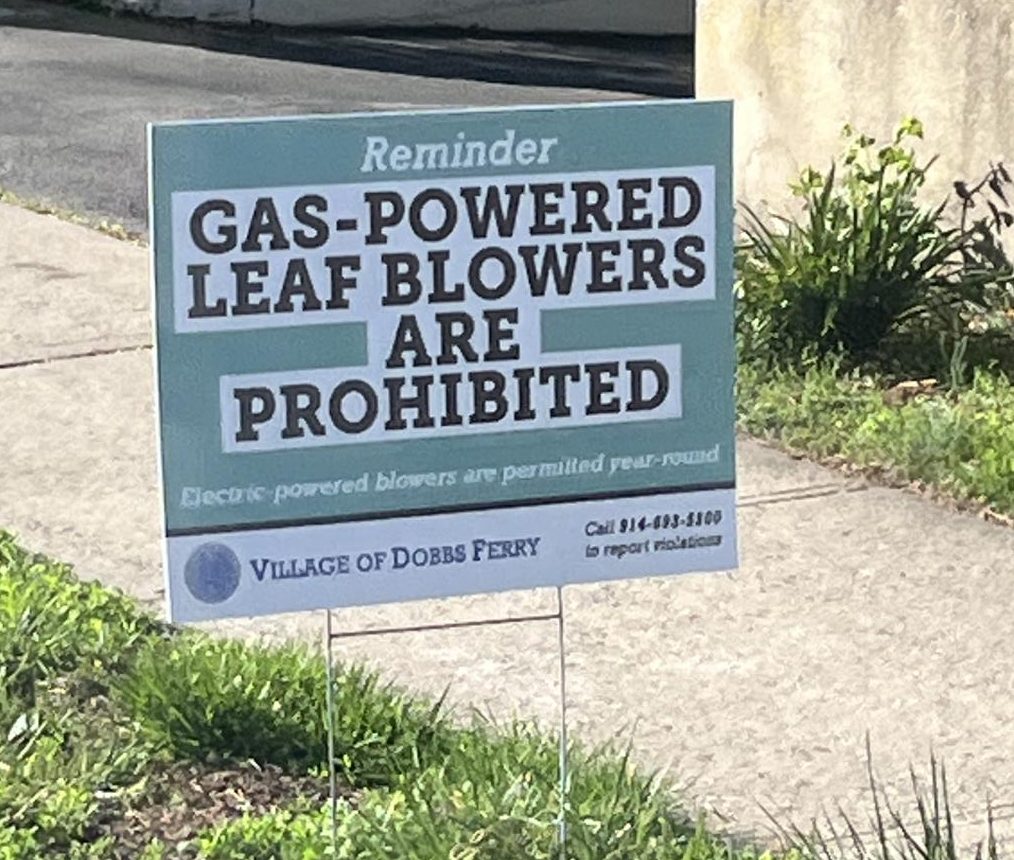
sound is fading. Dobbs Ferry has moved to phase out gas-powered leaf blowers entirely, part of a growing wave of local environmental action happening on the municipal level.
The town’s new law dramatically tightens restrictions on when the machines can be used, and sets the stage for a full ban. Earlier rules allowed seasonal use of gas-powered leaf blowers, but new legislation has gradually tightened those limits.
According to the village’s local law filing, gas-powered leaf blowers were previously permitted only between Oct. 15 and Dec. 15 during limited daytime hours. Beginning Jan. 1, 2026, the law states that “no person shall operate…any gas-powered leaf blower in the Village of Dobbs Ferry,” with fines that increase for repeat violations.
In March 2026, the Dobbs Ferry Board of Trustees adopted a resolution eliminating remaining exceptions and established a final date for the ban to go in place. The resolution sets May 15, 2026 as the date when gas-powered leaf blowers will be prohibited for routine use, leaving only narrow emergency expectations for utilities, municipal workers and emergency repairs. The law passed unanimously.
These laws help close a longstanding gap in environmental regulation by targeting small gas-powered engines that have historically faced fewer emission standards than cars. While automobiles have become significantly cleaner due to decades of emissions standards, catalytic converters and the rise of electric cars, many small gas engines – like those used in gas leaf blowers – still operate under fewer climate-conscious guidelines.
As a result, municipalities across the region are increasingly targeting landscaping equipment as a practical way to reduce local pollution. Dobbs Ferry is part of a growing trend in Westchester County and the Hudson Valley, where towns are experimenting with local environmental policies that can be implemented faster than state or federal legislation, and are also adopting seasonal bans or strict limits on gas-powered leaf blowers.
On the Masters campus, Director of Operations Dan Pereira explained the transition to electric equipment. “It does increase the time that it takes to get a whole [campus] done,” he said. “We have to buy multiple battery packs just to get through a few hours of work.” Despite these challenges, Pereira said the maintenance team supports the transition. “They have a job to do, but they’re also very eco-friendly so we knew this was coming,” he said. “Everybody’s in support of it—it’s just about efficiency.”
He also added that the switch has clear health benefits for workers as gas-powered blowers don’t have good filters. “For my guys, I feel much better about having them use [electric equipment] because they don’t have to worry about that exhaust all the time.”
For many residents, the ban represents an environmental and quality of life improvement. Upper School mathematics teacher Stella Car-
ey said she welcomed the decision. “I thought it was a great idea for two reasons. One is the pollution from the gas, and the other is the noise,” She said. “The noise affects people more directly…especially when we were trying to do a lot of Zoom calls and you’d have all this noise
outside.”
Carey noted that while pollution from small engines may be less visible day-to-day, its long-term impact matters. She also emphasized that the ban fits into the broader environments within the village. Dobbs Ferry’s active environmental committee promotes initiatives such as recycling, composting, walkability and community gardening. “This is a piece of that whole initiative,” Carey said.